The largest mass murder of priests in US history.

Ave María! May our Lady, Queen of All Saints, together with all the Saints and Martyrs, pray for us! Blessed All Hallows Eve, as the world focuses on that which is evil, I think it’s appropriate to similarly consider the saints and demons that shaped our world and are similarly both overlooked. On this day, 31 October 1696, Franciscan Father Luis Sanchez was killed while saying Mass at his chapel just 10 miles from our beloved St. Thomas More Priory. Father Sanchez is among the over two dozen priests who were killed evangelizing Florida or by British aggression. However, despite this high numbers of martyrs, Florida does not on the title of most martyred priests within these United States. That title belongs to New Mexico. The same number of priests killed over the course of two centuries in Florida were killed in a single event in New Mexico. In less than a week, 21 priests and friars, and hundreds of Catholic faithful were killed in a forgotten event called the Pueblo revolt of 1680. Whose leader was last seen in marble at flanking president Trump at his inauguration speech.
The Pueblo Revolt.
The evangelization of New Mexico began as early as 1539 with Friar Marcos de Niza OFM. New Mexico was populated by 21 distinct groups of people, over 40,000 in total when the first priest arrived. Don Francisco de Ibarra, a Spanish explorer, would call the place Nuevo México or New Mexico as it was a very populated area like Mexico City. In 1598 the first permanent Mission would be established, Mission San Gabriel in Ohkay Owingeh. Many more missions and settlements would follow. About 10 Franciscan friars would be martyred during this early evangelization of New Mexico. By 1670, Mission parishes and chapels dotted New Mexico. However, around that time a drought swept the region, causing a famine. This also increased raids by the Apaches which worsened the situation. Father Alonso de BenavidesOFM wrote multiple letters to the King, describing the conditions, noting "the Spanish inhabitants and Indians alike eat hides and straps of carts.” Unfortunately, shaman blamed the drought and famine on Christianity, which caused an extreme tension in the missions. This unrest came to a head in 1675 when Governor Juan Francisco Treviño ordered the arrest of 47 men who had reverted to paganism, and spread the idea that the old idols were punishing the area for accepting the Christian faith. These 47 men eventually attempted to start a revolt and apostasy among the mission residents. Thankfully these plans, which included killing priests and faithful Indian convert, were discovered and the ringleaders were arrested. Four of the apostates were sentenced to death by hanging; three of those sentences were carried out, while the fourth prisoner committed suicide. The remaining men were publicly whipped and sentenced to time in prison. When this news reached the tribal leaders, they moved in force to Santa Fe, where the prisoners were held. Because a large number of Spanish soldiers were away fighting the Apache and protecting the missions, Governor Treviño was forced to concede to the demands for the release of the prisoners. Among those released was a resident of Mission San Juan, whose baptismal name is unknown but later called himself "Po’pay. Filled with deep hatred Po'pay slowly began coordinating the insidious plot originally planned but on a much larger scale. This new and improved plan was Inspired by a vision Po’pay received when a he performed the demonic kachina dance. This dance- ceremony, was one where the dancer put on paint and a costume, becoming possessed by a “spirit from the underworld.”
In 1656 Father Alonso de Posada OFM, the superior of the New Mexico missions, had outlawed Kachina dances and ordered converts to burn their masks, idols, and all thing associated with their them. Father Posada also outlawed the use of entheogenic substances used in these ceremonies. By 1680 Po'pay had successfully recruited the warriors from the Taos, Picuris, Jemez, Kha'p'oo Owinge, Kewa, Tesuque, Ohkay Owingeh, Nambé, Zuni, Hopi, Navajo and Apache tribes. Po'pay told these warriors that the old gods had promised to end the drought as soon as Christianity was eradicated from New Mexico. He promised his warriors the gods would reward them with health and prosperity. The plan was for the inhabitants of each mission to rise up and kill their priest and all the Spanish and Catholic Indians in their area. Then all would unite and advance onto Santa Fe, the capital of New Mexico. The date set for the uprising was 11 August 1680. Po’Pay dispatched runners to all the missions carrying knotted cords. Each morning the rebel leadership was to untie one knot from the cord, and when the last knot was untied, that would be the signal for them to rise against the missions. Only two tribes that stayed loyal to the Catholic faith, l the southern Tiguex and the Piro. Faithful from those tribes alerted the Spanish and the revolt took place a day earlier.
On 10 August the rebels rose up, stole the Spaniard’s horses to prevent them from fleeing, sealed off roads leading to Santa Fe, and pillaged Spanish settlements. Dozens missions saw uprisings or were attacked by Po’pay’s forces. Of the 34 Franciscan friars who lived in New Mexico, 21 of them were killed. Over 400 Catholics were killed, including men, women, and children. By August 13, all the Spanish settlements in New Mexico had been destroyed and Santa Fe was besieged. The rebels surrounded the city and cut off its water supply. In desperation, on 22 August, New Mexico Governor Antonio de Otermín, took a force of all of his available men and forced the rebels to retreat with heavy losses. He then led the Spaniards and faithful Indians out of the city. The Spanish refugees retreated southward along the Rio Grande with their statue of Our Lady, and settled in El Paso del Norte which is today El Paso TX and Juarez MX.
The aftermath of the revolt.
Once the Spanish left Santa Fe, Po'pay and his most loyal warriors traveled from town to town ordering a return paganism. All crosses, churches, and Christian images were to be destroyed. The people were ordered to cleanse themselves in ritual baths, to use their former names or choose new non-Christian ones, and to sacrifice to idols. He also ordered all vestiges of the Roman Catholic religion to be destroyed, including livestock, crops, literature, and fruit trees. Po'pay, forbade the planting of wheat and any non-native crop, and commanded those natives who had been married in the Church to dismiss their wives and to take others after the old native tradition. Naturally, many resisted these commands and where the friars had brought unity among the tribes, Po’Pay brought unrest. Po'pay’s policies only worsened the situation of starvation and unrest among the New Mexico tribes. Po’Pay was quickly betrayed by the Apache, who began attacking his villages. The paradise Po’Pay had promised when the Spanish were expelled did not materialize. Initially, however, the rebels were united in their objective of preventing a return of the Spanish. However, as the promises of the old gods never came about, Po’Pay was deposed about a year after the revolt. He would later disappears from history, likely being killed by Apache warriors or unhappy people Indians.
Our Lady’s Holy reconquista of New Mexico.
With Po’Pay out of the way, the tribes attempted to sustain themselves but eventually some of the tribes requested for the Spanish to return. The Spanish reconquest or reconquista of New Mexico began when several of the tribes invited the Spaniards to return in 1691. In August 1692, Don Diego de Vargas marched to Santa Fe unopposed along with 60 soldiers, 100 native warriors, 1 Franciscan priest and the statue of Our Lady. This forces arrived at Santa Fe on 13 September. Don Vargas promised clemency and protection to any tribes that would swear allegiance to the King and return to the Christian faith. On 14 September 1692 Don Vargas proclaimed a formal act of repossession of New Mexico. Don Vargas reconquered 13 towns for God and King in this manner. During the next month Don Vargas visited other Pueblos and accepted their acquiescence to Spanish rule. New Mexico was a possession of Christendom once again. At every meeting Don Vargas took that statue of Our Lady.
The last stand was when 79 shaman and 500 pagan braves United to keep to stop the return of Catholicism. This resulted in a quick and decisive battle on 30 December 1692. With this victory, Our Lady was processed into St. Francis Church through the streets of Santa Fe and a Solemn Mass was said. This is a tradition which survives to this day to commemorate this victory. By 1696 the last resisting town had surrendered and at the cost of more Martyrs blood, Christendom had conquered New Mexico once again. Eventually the Missions were rebuilt and the people of New Mexico accepted their Lord, Christ the King. In 1920, the Knights of Colombus erected a Cross in honor of the 21 Franciscan friars and over 400 faithful Catholics who were killed in the Pubelo revolt.
The Pueblo revolt in the modern day and its odd connection to clowns.
In more recent times this revolt has been praised as “the first American revolution.”
A statue of Po'pay is enthroned not only in the New Mexico State capital, but also in the National Capitol in Washington DC in 2005. According to the statues sculptor Cliff Fragua, Architect of the capital website, describes the statues features: “The bear fetish in his right hand symbolizes the center of the Pueblo world, the Pueblo religion.” It’s nice to know that a man who lead an army to murder over 400 people for their Catholic Faith, along with 21 priests and friars, is honored in Washington. Sculptor Fragua continues: “On his back are the scars that remain from the whipping he received for his participation and faith in the Pueblo ceremonies and religion.”
It is interesting that he did not mention that Po’Pay was scourged for planning to murder a priest, a dozen soldiers and their families, and any Indian who did not agree with him. As they say, the victor writes the history. With this I will Segway into one of the undertones of this story and on the more conspirator-non serious aspects. It’s commonly agreed by most historians that the primary cause of the Pueblo Revolt was the attempt by the friars banning traditional dances and idols such as these kachina dolls. Those agitated by these bans rode the waves of unrest that came about from the drought and famine. However, studying these ceremonies closer one begins to notice that among these dancers is a type of clown, each tribe having one according to its own tradition. Called Pueblo clowns, they are often painted with black and white stripes, given two long horns on the top of theirs head and a large painted smile. These clowns performed important ceremonies, monthly rituals, summer (for rain), November - for the “gods”, for “curing”society and magic. The Franciscans made it clear in their documents that the ban on these dances, masks, and hallucinogens, was not only because it was considered idolatry but it also opened those involved with demonic possession. The friars write of the payasos (clowns), as though it is an ancient pagan custom long condemned.
What the friars are likely referring to were the ancient “sacred clowns” of Egypt and later Rome. Yes, the natives of New Mexico were not alone in ceremonial demonic clowns. The Egyptian clowns served a socio-religious and psychological role, and traditionally in ancient Egypt the roles of priest and clown had been held by the same person. In Rome, clowns served more of a purpose of entertainment than a ceremonial role. However these clowns and other forms of theatrical arts, were later suppressed by the Church during the fall of Rome as being morally questionable. The first official re-emergence of clowns was the Harlequin. A strong departure from the medieval jester, the Harlequin appeared in the mid 1500s. Unlike jesters who served as mere entertainment, the harlequin carried an occult symbolism, a revival of ancient times from before the rule of the Church.
The harlequin’s name comes from a mischievous "devil" character in the popular French Passion Plays. It originates with an Old French term herlequin, hellequin, first attested in the 11th century, by the Benedictine chronicler Orderic Vitalis, who recounts a story of a monk who was pursued by demons when wandering Normandy at night. These demons were led by a masked, club-wielding giant and they were known as familia herlequin. At first Harlequins were primarily found in the renaissance theaters which belonged to the elite families of Europe. These first clowns and other forms art saw a revival with the renaissance. Since the conversion of Rome, the Church had suppressed such pagan and morally questionable traditions. By the 1700s the harlequin had slowly become something closer to a clown. The first true modern Circus clown was Joseph Grimaldi, an English actor, comedian, and dancer. This first clown, in keeping with the esoteric theme of harlequin, started with appearances in the plays: triumph of mercury, Harlequin’s wedding and the Talisman. Perhaps related, Joseph Grimaldi was initiated into Freemasonary at the St. James lodge in Wheatsheaf, London. He ensured that his clown’s performance was mixed with occult ritual and ancient pagan traditions. Though it is despited, Sir Grimaldi likely took the look of white face paint and bright red from Rakshasas, “demon deities” which are found in eastern religions like Hinduism, Buddhism, and Islam. At the time, India was under the rule of the British and it is believed Grimaldi's clown makeup were inspired by a friend's description of these Rakshasas. Was there more than bright colors in Grimaldi’s mind when he dressed his character like a foreign Hindu demon? Was the harlequin, a name reserved by monks for demons, more than just a symbol of rebellion to the establishment? Did dressing like a demon clown have a deep influence on Po’Pay when he led the largest mass murder of priests on the continent? We will never know the answers to these questions until the end of time but it really does make you consider how influenced our world really is against Christ and His Church.
The Martyrs of the Pueblo revolt against the New Mexico Missions.
Father Juan Bernal OFM.
Father Bernal was born in Mexico City and was ordained a Franciscan priest there. In 1680 he was the superior of the Missions of New Mexico. Father Bernal was killed in Santa Fe by Po’pay’s rebels on 10 August 1680.
Father Juan Bautista Pío OFM.
Father Pio was born in Vitoria, Spain and became a Franciscan priest at Cantabria. On 10 August 1680, Father Pio was killed outside of Mission San Lorenzo in Tesuque, New Mexico. Before he was riddled with arrows, he said to the rebels: “What does all this mean, my children? Are you crazy? Do not disturb yourselves for I will aid you and will die a thousand deaths for you. For the love of God not to kill anybody.” Father Pio was the first priest to be killed in the Pueblo revolt.
Father Domingo Vera OFM.
Father Verá was born in Mexico City and was ordained a Franciscan priest there. On 10 August 1680 Father Vera was killed in his convent in Mission San Marcos in Galisteo, New Mexico.
Father Francisco Lorenzana OFM.
Father Lorenzana was born in Galicia, Spain and became a Franciscan priest there. On 10 August 1680, Father a Lorenza a was killed inside the Church of Mission Santo Domingo in Kewa Pueblo, New Mexico. Father Lorenzana’s remains are buried in El Paso, TX.
1680 Fr. Lucas Maldonado, OFM
Father José Montes de Oca OFM.
Father Montes was born in Queretaro, New Spain (Mexico) and became a Franciscan priest at Michoacán. On 10 August 1680, Father Montes was burned alive at Mission Santo Domingo in Kewa Pueblo, New Mexico. Father Montes’ remains are buried in El Paso, TX.
Father Antonio Mora OFM.
Father Mora was born in Puebla de Los Angeles, New Spain (Mexico) and became a Franciscan priest at Michoacán. On 10 August 1680 Father Mora was killed at San Geronimo Convent in Taos, New Mexico, along with a few Spanish soldiers and settlers.
Father Luis Morales OFM.
Father Morales was born in Baeza, Spain and became a Franciscan priest in Mexico City. On 10 August 1680, Father Morales was killed at the foot of the altar while saying Mass at Mission San Ildefonso outside of Santa Fe.
Friar Antonio Sánchez Pro OFM
Friar Antonio was born in Mexico City, and there he became a Discaled Franciscan friar. On 10 August 1680 Friar Antonio was killed while serving the Mass of Father Luis Morales at Mission San Ildefonso outside of Santa Fe.
Friar Juan de Pedrosa OFM.
Friar Juan was born in Mexico City and became a Franciscan friar there. On 10 August 1680 Po’Pay’s rebels “mercilessly” killed Friar Juan at the Covent in the San Lorenzo convent in Taos, New Mexico.
Father Matías Rendón OFM.
Father Rendón was born in Puebla de Los Angeles, New Spain (Mexico) and became a Franciscan priest at Mexico City. On 10 August 1680, Father Rendón was killed at the San Lorenzo convent in Taos, New Mexico.
Father Juan Talaban OFM.
Father Talaban was born in Seville, Spain and became a Franciscan priest there. On 10 August 1680 Father Talaban was burned alive at Mission Santo Domingo in Kewa Pueblo, New Mexico. Father Talaban’s remains are buried in El Paso, TX.
Father Manuel Tinoco OFM.
Father Tinoco was born in Extremadura, Spain and was ordained a Franciscan priest at the San Miguel monastery. On 10 August Father Tinoco was killed by Po’Pay’s rebels, who beat him and burned him alive outside of Galisteo, New Mexico.
Father Tomas Torres OFM.
Father torres was born in Tepozotlán,, New Spain (Mexico) and became a Franciscan priest at Mexico City. On 10 August 1680 Father Torres was killed at Mission San Francisco in Nambé Pueblo, New Mexico.
Father Fernando Velasco OFM.
Father Velasco was born in Cadiz, Spain and after he became a Franciscan priest, he volunteered to go to the Missions in North America. Father Velasco was killed at Pecos
on 10 August 1680 while attempting to notify his superior of the revolt. Father Velasco was struck on the head with a tomahawk.
Father José Espeleta OFM.
Father Espeleta was born in Navarro, Spain and became a Franciscan priest there. On 11 Augaust 1680 Po’Pay’s rebels captured Father Espeleta and forced him into slavery. Father Espeleta died on 31 august due to torture and mistreatment near Walpi Arizona.
Father Agustin Santamaría OFM.
Father Santamaría was born in Michoacán, New Spain (Mexico) and became a Franciscan priest there. On 11 August 1680, Father SantaMaria was killed while enroute to Zuni, Arizona. Father SantaMaria knelt before his attackers, folded his hands in prayer and commended his soul to God. The rebels pierced him with a spear and struck his head with a hatchet.
Father José Figueroa OFM.
Father Figueroa was born in Mexico City, New Spain (Mexico) and became a Franciscan priest there. On 11 August 1680, Father Figueroa was killed at Mission San Bernardino in Awatobi, Arizona. Father Figueroa was beaten to death by Po’Pay’s rebels and his body was thrown in a cave.
Father José Trujillo OFM.
Father Trujillo was born in Cadiz, Spain and later became a Franciscan priest in the Philippines. On 11 August 1680, Father Trujillo was killed at mission of San Buenaventura in Shongopovi, Arizona by Po’Pay’s rebels.
Father Juan JesúsMaría OFM.
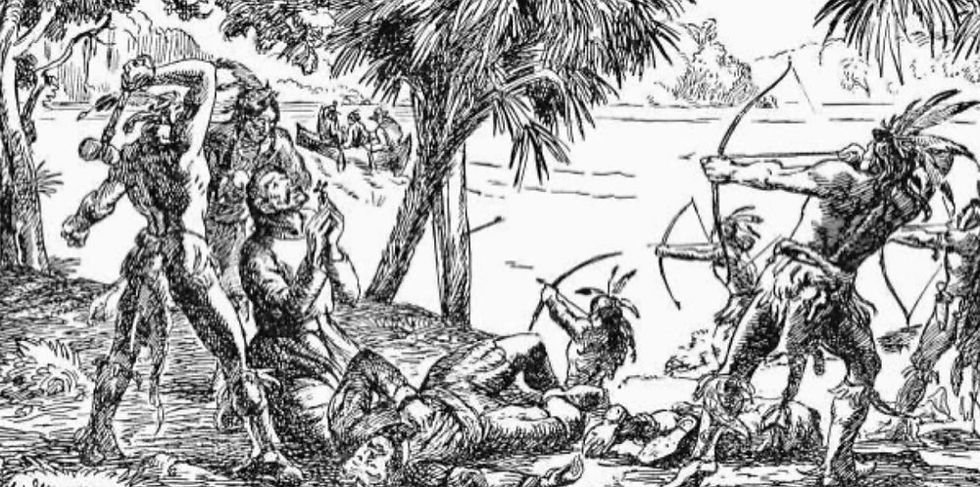
Father JesúsMaría was born in Granada, Spain and became a Franciscan priest at Andalucia. On 10 August 1680, Father JesusMaria was killed at Mission San Diego de Jemez in New Mexico. When Po’Pay’s rebels were approaching Father JesusMaria he knelt whole holding a crucifix in his hands and commended his soul to God. The rebels riddled him with arrows and tied him up to a boar and dragged him through the streets of the town until he finally died while forgiving his executioners. Father Jesusmaria is buried at the Cathedral of St. Francis in Santa Fe.
Father Juan Val OFM.
Father Val was born in Castile, Spain, and became a Franciscan priest there. On 11 August 1680 Father Val was killed by Po’Pay’s rebels at Mission Immaculate Concepción de María in Halona, New Mexico.
References:


Comments